
Hennessy Garcia at New York City Students 4 Justice protest, 2020.
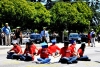
A protest is an event or action where people gather with others to publicly express their opinions about something that is happening in society. There are a variety of potential goals for a protest: influence public opinion, draw attention to and share information about a perceived injustice, gain a wide audience for the cause, push public policy or legislation forward, learn more about an issue, connect with others who feel passionate about the issue, speak one's truth and bear witness. Protests can also provide inspiration and a sense of being part of a larger movement. The overarching purpose of protests is to demand change.
Protests can take the form of marches, sit-ins, boycotts, and include speeches, music, chanting, performance art, poetry, using symbols, holding signs and confronting people, assembling near symbols and in places of significance to the cause (e.g., a monument) or occupying a specific building or space. Protests are among the many strategies people use to engage in activism and organizing, with the goal of enacting change. Other ways to engage in activism include advocacy for legislation, public awareness campaigns, raising funds, gaining support through social media, among others. See ADL's 10 Ways Youth Can Engage in Activism for more ideas.
Non-violent resistance (also called civil disobedience) is a form of protest. This type of protest is characterized by people engaging in a symbolic protest or peacefully refusing to cooperate. An example of non-violent resistance are the sit-ins that began in 1960 as part of the Civil Rights Movement. Young African American college students organized a sit-in at a segregated Woolworth’s lunch counter in Greensboro, N.C. where they refused to leave when told they were not allowed to eat there. The sit-ins spread to other college towns in the South. Many of the protesters were arrested for trespassing, disorderly conduct or disturbing the peace. Their protest had an immediate and lasting impact, picking up media attention and ultimately forcing Woolworth’s and other dining facilities to change their segregationist policies.
In the U.S., protesting is a legal right granted by the First Amendment of the Constitution. The government may limit the time, place and manner, but the restrictions must be reasonable and fair. The government cannot forbid you and others from assembling to discuss or protest issues. However, since the First Amendment also stipulates that protests be peaceful, violent protesting is a violation of the law.
Sometimes looting (i.e., stealing) and violence takes place at protests. These actions may be taken by protesters or non-protesters (i.e., outsiders) who take advantage of the situation. Even though these activities are rare, they can be magnified by the media and others to garner attention and become a distraction from the focus of the protests. Throughout history, there have been times when law enforcement engaged in crackdowns on peaceful protests. According to the ACLU, "In some cases, police crack down on demonstrations through mass arrests, illegal use of force, or curfews." These crackdowns have the potential to ignite counter-violence by protesters.
The United States has a long history of protest and activism. Young people have often been at the center of those protests. Protestors have advocated and demanded change for child labor laws, workers’ rights, voting rights, civil rights, anti-war, school desegregation, immigrant and refugee rights, LGBTQ equity, climate change, Confederate monuments, racial justice, gun violence and more.
To learn more about the history of protests in the United States, consider a resource like PBS’ Fighting for a More Perfect Union.
Age
8 and up
(Note: To have a conversation about this with younger children, consider starting the conversation by reading a book like Enough! 20 Protesters Who Changed America.)
Questions to Start the Conversation
Questions to Dig Deeper
Take Action
Ask: What can we do to help? What actions might make a difference?
Additional Resources